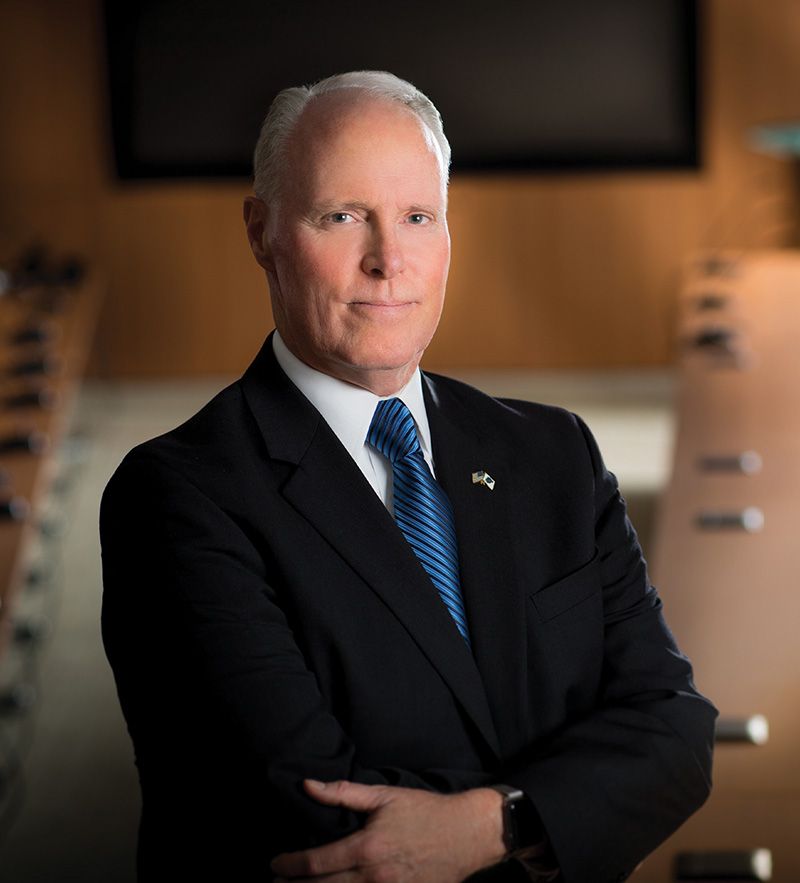
Chris Van Gorder, FACHE
President and CEO, Scripps Health
JOIN US AT PARTNERS’ 26TH ANNUAL VISION & EXCELLENCE IN HEALTHCARE LEADERSHIP TRIBUTE DINNER
Biography
As President and CEO of Scripps Health for the past 25 years, Chris Van Gorder has now successfully led the organization through a quarter of its 100-year history.
Board certified in health care management and an American College of Healthcare Executives (ACHE) Fellow, Van Gorder leads all functions of the San Diego based integrated health system, including its five acute-care hospital campuses, and more than 30 outpatient and specialty centers, including the Prebys Cardiovascular Institute and the Scripps Cancer Center.
Van Gorder’s path to health care leadership was unconventional. A former police officer injured in the line of duty, his journey began as a hospital patient. Following a complex and lengthy recovery, he secured a job at the hospital where he had received his care, continued his health care management education and rose to new levels of responsibility.
More than 18,000 employees and 3,500 affiliated physicians provide care at Scripps, which has made Fortune magazine’s “100 Best Companies to Work For” list for 18 years and was recently recognized again by U.S. News & World Report as one of the top five medium sized health systems in the nation.
Among his accomplishments, Van Gorder led a financial and cultural turnaround, significantly expanded the Scripps’ integrated health system, established a dyad leadership model where administrators and physicians co-lead health care operations, and created an innovative Model Care program, empowering staff and physicians to continuously redesign patient care.
Van Gorder is also known for his community contributions. He recently retired as Reserve Assistant Sheriff for San Diego County, and last year spearheaded the formation of San Diego’s Hospital Workplace Violence Taskforce, bringing together local law enforcement, the District Attorney’s office and other San Diego health system leaders to reduce incidents of violence against health care workers. In past years he also led medical relief missions following Hurricane Katrina and the 2010 Haiti earthquake.
Van Gorder received his master’s degree in public/health services administration at the University of Southern California, completed the Wharton System CEO Program at the University of Pennsylvania and earned his bachelor’s degree from California State University, Los Angeles. His first book – The Front-Line Leader: Building a High Performance Organization from the Ground Up – was published in November 2014.
Honorary Co-Chair
Jeff Bowman Fire Chief, San Diego
Chris Van Gorder’s Part 1 Interview
A Career Shaped by Service
Chris Van Gorder’s career places him among the most respected healthcare leaders in the nation.
He is a past recipient of the American College of Healthcare Executives Gold Medal Award, ACHE’s highest honor, for his contributions to healthcare services and community health. For multiple years, Modern Healthcare has named him one of the 100 Most Influential People in Healthcare. In 2022, Becker’s Hospital Review recognized him as one of the nation’s Great Healthcare Leaders, honoring executives who “champion innovation and have built a solid cultural foundation for success in the future.”
Under Van Gorder’s leadership, Scripps Health has earned sustained national recognition. The organization has appeared on Fortune magazine’s “100 Best Companies to Work For” list for 18 consecutive years. In its 2025 Best Hospitals rankings, U.S. News & World Report named Scripps one of the top five medium-sized health systems in the nation. Scripps Green Hospital and Scripps Memorial Hospital La Jolla were ranked among the best in six clinical specialties, including cardiology, orthopedics, geriatrics, and gastroenterology.
“I learned a lot about how to make decisions when I was a police officer,” Van Gorder said. “As a cop, you don’t have perfect information, so you have to act as if somebody’s going to die if you make the wrong choice. As a CEO, I don’t have perfect information, but I’ve learned to trust my decision-making. It’s not about trusting your guts so much as trusting your experience and training.”
That philosophy was shaped early.
Van Gorder grew up the son of immigrants who left high school during the Great Depression. His father worked as a milkman, delivering glass bottles door to door, and his mother worked in a bookstore. Their aspiration for their twin sons was simple and unwavering: the opportunity for a college education and a belief that public service was not optional.
While in college, Van Gorder worked for the LAPD through its Police Student Worker program. Around the same time, he replaced his twin brother as a clerk in the emergency department at Huntington Memorial Hospital.
“Whoever was sitting at the front desk did all the triage,” he said. “And I loved the job. That was my first foray into healthcare.”
After graduating, he pursued law enforcement full time and joined the Monterey Park Police Department. Several years later, while responding to a domestic disturbance call, his patrol car was intentionally struck head-on. The injuries were severe and forced his retirement from the police force.
The recovery took more than a year.
“I’ve often said the worst day in your life could end up being the best day in your life,” Van Gorder said. “You just never know what’s going to happen.”
Once recovered, he returned to healthcare in a leadership role at the Los Angeles Orthopaedic Hospital. Determined to deepen his understanding of hospital operations, he immersed himself in cross-functional work and later earned a Master of Public Administration in healthcare administration from the University of Southern California.
His career advanced through senior leadership roles across Southern California before he arrived at Scripps Health in 1999. Almost immediately, he encountered an organization under strain, both financially and culturally.
“The medical staff hated the strategic plan and hated administration,” he said. “For the next few months, all hell broke loose.”
When the CEO was replaced, Van Gorder was asked to step in as interim CEO. From his first days in the role, he identified a core challenge.
“Information wasn’t being shared as transparently as it needed to be,” he said. “My hypothesis was that if we could fill the gap of information, we’d likely reach the same conclusions.”
That belief would soon be put to the test.In Part Two, Van Gorder looks back on the decisions that followed, and how a commitment to transparency and culture ultimately reshaped an organization and its future.